¡Great! 200 Common Redundancies - Cut Redundant Expressions http://t.co/jLvrNTLLse #contentstyle
— Maria Benito Llaurad (@Marialacopy) December 9, 2013Sunday, 15 December 2013
200 Common Redundancies


Friday, 13 December 2013
Hilarious tweets
Ancient grammar police! Funny! http://t.co/cSS7dgVsxU #plainlanguage
— Cntr 4 PlainLanguage (@plain_language) October 31, 2013The best case ever for the Oxford comma: pic.twitter.com/gDt1gUOfJk
— Aaron Zamost (@zamosta) December 10, 2013Funny headlines http://t.co/DYUlWSjE3n #plainlanguage
— Cntr 4 PlainLanguage (@plain_language) October 24, 2013Monday, 15 July 2013
Fair better or fare better?
According to yesterday's Times of India, "doctors' children fair better than that of engineers" in IIT entrance exams.
Nope; they fare better.
The second mistake is the use of that, which refers to children. Since children is plural, the sentence should have read: Doctors' children fare better than those of engineers.
Nope; they fare better.
The second mistake is the use of that, which refers to children. Since children is plural, the sentence should have read: Doctors' children fare better than those of engineers.
Thursday, 30 May 2013
I wish I were an astronaut
I wish I were an astronaut on the International Space Station; I could then look out through the portholes and take in breathtaking views of the Earth. Sadly, I am not.
But what does this have to do with the English language?
Well, when we talk of situations which are not true (for example when we express a wish) we should use a verb in the subjunctive mood. In the sentence If I were an astronaut..., were is in the subjunctive mood because I am talking about a situation which is not real. Many people would have written If I was an astronaut..., where was is in the indicative mood.
Similarly, the song If I were a rich man from the movie Fiddler on the Roof correctly uses the subjunctive were because the character in the film is not rich; he is just singing about what he would do if indeed he were rich.
Likewise, were is correctly used in the following sentences:
It is for this reason that If God was a Banker, a novel written by Ravi Subramanian, should have used the subjunctive, were, in the title. The same holds true for the Ronan Keating song Carrickfergus, whose first line reads: I wish I was in Carrickfergus; were would have been more appropriate. Ditto for Enrique Iglesias' Wish I was your lover.
You can read more on this topic here and here.
The use of the indicative was is very common, nevertheless. A google search for "I wish I was" produced 350 million results whereas "I wish I were" gave 59.4 million.
But what does this have to do with the English language?
Well, when we talk of situations which are not true (for example when we express a wish) we should use a verb in the subjunctive mood. In the sentence If I were an astronaut..., were is in the subjunctive mood because I am talking about a situation which is not real. Many people would have written If I was an astronaut..., where was is in the indicative mood.
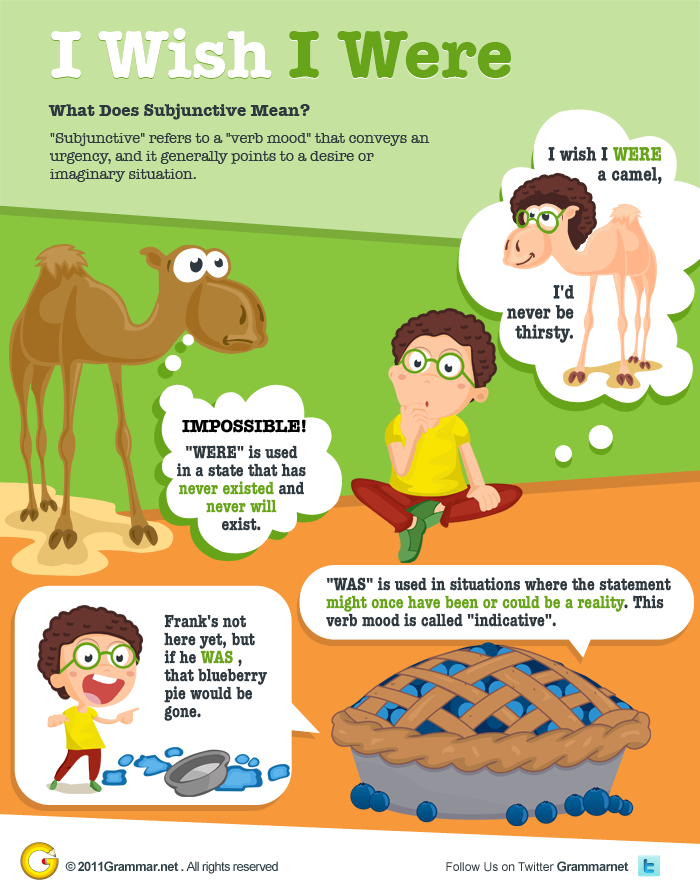 |
| Source: www.grammar.net/iwishiwere |
Similarly, the song If I were a rich man from the movie Fiddler on the Roof correctly uses the subjunctive were because the character in the film is not rich; he is just singing about what he would do if indeed he were rich.
Likewise, were is correctly used in the following sentences:
- If I were you I would... (in reality I am not you)
- If you were the Prime Minister what would you do to tackle corruption? (in reality you are not the Prime Minister)
- I wish you were here.
It is for this reason that If God was a Banker, a novel written by Ravi Subramanian, should have used the subjunctive, were, in the title. The same holds true for the Ronan Keating song Carrickfergus, whose first line reads: I wish I was in Carrickfergus; were would have been more appropriate. Ditto for Enrique Iglesias' Wish I was your lover.
You can read more on this topic here and here.
The use of the indicative was is very common, nevertheless. A google search for "I wish I was" produced 350 million results whereas "I wish I were" gave 59.4 million.
Monday, 7 January 2013
Prone vs Supine
I don't know about you but I used to think that these two words were synonyms. They are not. A person is prone when they lie on their stomach and supine when they lie on their back.
 |
| Prone Photo: Daily Mail |
 |
| Supine Photo: Finger Lakes Runners Club |
Subscribe to:
Posts (Atom)