Showing posts with label grammar. Show all posts

Wednesday, 14 September 2016

Rest assured

According to Cambridge Dictionary, rest assured means to be certain that something will happen and gives this example: You can rest assured that you're going to get a good deal.

Quite often, however, I have seen it used with a be before it, like in the following examples:

  • It may sound quite amazing and perhaps unbelievable, but you can be rest assured that what you're about to read is completely true.
  • By choosing us you can be rest assured that your facility, project...
  • ...you can be rest assured you have full rights to use all images...

This is not correct.

The rest in rest assured is a verb which means to relax, to not worry. You'll understand the expression better if you imagine a comma after rest. So you could paraphrase the first example as
...but you can rest, assured in the knowledge that what you're about to read is completely true. 
 Now you can easily see why be rest assured doesn't make sense. 

Monday, 15 July 2013

Fair better or fare better?

According to yesterday's Times of India, "doctors' children fair better than that of engineers" in IIT entrance exams.

Nope; they fare better.

The second mistake is the use of that, which refers to children. Since children is plural, the sentence should have read: Doctors' children fare better than those of engineers.

Thursday, 30 May 2013

I wish I were an astronaut

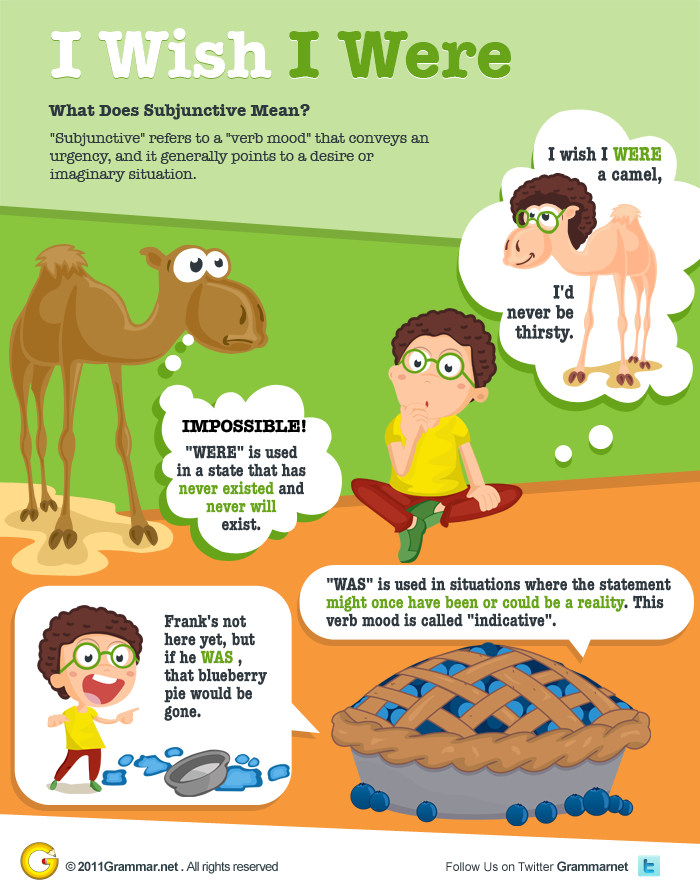
I wish I were an astronaut on the International Space Station; I could then look out through the portholes and take in breathtaking views of the Earth. Sadly, I am not.

But what does this have to do with the English language?

Well, when we talk of situations which are not true (for example when we express a wish) we should use a verb in the subjunctive mood. In the sentence If I were an astronaut..., were is in the subjunctive mood because I am talking about a situation which is not real. Many people would have written If I was an astronaut..., where was is in the indicative mood.

Source: www.grammar.net/iwishiwere


 Similarly, the song If I were a rich man from the movie Fiddler on the Roof correctly uses the subjunctive were because the character in the film is not rich; he is just singing about what he would do if indeed he were rich.

Likewise, were is correctly used in the following sentences:
  • If I were you I would... (in reality I am not you)
  • If you were the Prime Minister what would you do to tackle corruption? (in reality you are not the Prime Minister) 
  • I wish you were here.
You might have noticed that the second part of such sentences usually contains would or could.

It is for this reason that If God was a Banker, a novel written by Ravi Subramanian, should have used the subjunctive, were, in the title. The same holds true for the Ronan Keating song Carrickfergus, whose first line reads: I wish I was in Carrickfergus; were would have been more appropriate. Ditto for Enrique Iglesias' Wish I was your lover.

You can read more on this topic here and here.

The use of the indicative was is very common, nevertheless. A google search for "I wish I was" produced 350 million results whereas "I wish I were" gave 59.4 million.


Thursday, 27 December 2012

Use twitter to improve your English

Are you on Twitter? If yes, here is a list of accounts that you might like to follow:

And why not visit this page to see how good your spellings are: Oxford dictionaries spelling challenge

Sunday, 3 June 2012

"Post" as a preposition

The rampant misuse of post as a preposition is my pet hate these days. I wonder why it has spread so fast among people who should have known better: the press. What happened to after? If you don't know what I am talking about, take a look at the following sentences:
  • Post the match, the crowds were thrilled when SRK did a victory dance on the ground! (The Times of India)
  • Post the war, the country witnessed escalated levels of unemployment... (Hindustan Times)
  • Director Imtiaz Ali says he is yet to decide on his next film post the success of 'Rockstar'. (Indian Express)
  • The ICPA pilots, numbering about 650, have been demanding for long parity in service conditions post the merger of Air India and Indian Airlines... (Asian Age)
In each of these sentences post has been used incorrectly; a preposition like after should have been used instead. But what on earth is a preposition? Macmillan Dictionary describes it as:
A word that usually comes before a noun or a pronoun and shows its relation to another part of the sentence. In the sentences 'I left it on the table' and 'she came out of the house', the words 'on' and 'out of' are prepositions.
 After can be used as a preposition; post cannot. 

 The reason for the confusion is that post does indeed mean after, but only when it is used as a prefix like in the following examples:
  • a post-match celebration (not celebration post the match)
  • the post-war economy (not the economy post the war)
  • a post-dated cheque
  • a post-impressionist painting
  • post-partum depression
  • post-traumatic stress disorder
  • post-exercise recovery
So if you too are a victim of this misunderstanding, I hope that post reading this ... er ... after reading this you know how to use post.

Saturday, 29 January 2011

Murder of the English Language

This is the second post with murder in the title but I assure you I am not a psychopath. Anyway, I have been thinking about this subject off and on for quite some time but I have finally decided to write about it after I read the following comments on Yahoo India in response to a news item about the Arushi murder case:

  • Oh defntly d parnts. God wl nevr 4giv u bloody murderer. How kud u kill ur own child. My gosh!!! M jus stunnd... I jus wish Arushi's soul 2 rest in peace & I hope dat she gets justic vry soon...
  • i hav a question 2 arushi'z parents...y are u not pleading for justice for ur daughter???
    werz d got @#$% justice???
  •  malini i feel u have a point.i too have these question in mind which is unanswered.
    I dnt understand when we being the individuals can think of so many questions with only knowing what they tell us without even knowing the complete truth hw do they work? Exactly abt internet the router was switched off at 3 am y ? wat it is concerned with the killer to net being offed or on. Until its some one from home to be concerned for it.
This blog entry is not about the tragic murder of Arushi and the events which followed but about the murder of the English language which is being committed in full public view. Thankfully, most of the other comments were closer (but not always close enough) to standard English than the ones quoted above.

I wonder why many Indians write like this online. Is it really so difficult / inconvenient / unnecessary to write simple, grammatically-correct sentences with reasonably good spelling? I do understand that there are many Indians who do not know this language very well but that does not explain the kind of  deliberate mis-spellings and incoherent sentences like the ones above. And I'm nt talkin abt SMSs & tweets, both of which offr vry ltd spac 4 msgs : ) I don't know about you but dis and dat in particular really get my goat; does it take too much effort to write this and that?

 To me it is akin to a candidate for a job going for the interview with unkempt hair and dressed in a scruffy shirt, torn trousers and dirty shoes; he would make a very bad impression on the interviewer and might not get the job even though he might be very good at what he does. Similarly, such slapdash writing leaves the reader with a poor impression of the writer and he might not even feel like reading all that has been written. 

But let me give them the benefit of doubt; maybe there are good reasons why they write the way they do. Here are a few possibilities that I can think of:

  • Some people lead extremely busy lives and omitting a few letters saves them a few seconds each day.
  • There are some who type with only one or two fingers, so leaving out a few characters here and there saves them a lot of time and energy.
  • Maybe they are simply rebelling against the arbitrary way in which English words are spelt and want to turn it into a phonetic language like Hindi and Spanish; so they write wud, cud and bcoz instead of the weird manner in which the dictionaries spell them.
  • It is a conspiracy by Pakistan's ISI.
  • It is a Chinese conspiracy to undermine Indians' knowledge of English.
If you can think of any other equally plausible explanations please leave them in the Comments section below.

End of rant.

Wednesday, 11 August 2010

Who vs Whom

It seems to me that many people, not just Indians, do not use the pronoun whom very often, if at all; maybe they do not know when to use it, so they just stick to who. 

In order to get an idea of how widespread this practice is, I googled "who did he talk to" and got 599,ooo results. Then I searched the grammatically correct version of that sentence, "whom did he talk to", and got a mere 49,000 results! 

I performed another search and the results were equally revealing. This time I entered "who do you think you are talking to"  and it's grammatically correct sibling "whom do you think ..."; the results for the former were many times greater than for the latter.


But it's not difficult to understand if you put in a little effort.  Let me explain.


 Who and whom are used just like he and him. All four of these words are pronouns; who and he are known as 'subject pronouns' while 'whom' and 'him' are 'object pronouns'. The subject of a sentence is a noun or a pronoun which performs an action and the object is the recipient.

Let's take an example. Let's suppose that a female teacher scolded one of her male students. Using pronouns we can say:


"She scolded him." The female teacher was the one who performed the action, so she is the subject and is represented by the subject pronoun she, and the student is represented by the object pronoun him.

 If you don't know who the recipient of the action was then you can ask the question "Whom did she scold?" using the object pronoun whom.  Here, who would have been wrong since it can represent only the subject of a sentence, which in our example is the teacher.

Let's take the first sentence that I googled, "who did he talk to". Imagine yourself answering that question with "he talked to ____". Here, he is the subject since he is the one performing the action of talking. So the pronoun to fill the blank will have to be the object pronoun whom, not the subject pronoun who.

Similarly, if you were to answer the second sentence, "who do you think you are talking to", you would say "I am talking to _____". Here again, I is performing the action and is therefore the subject and the recipient of the action, and the object, needs to be represented by the object pronoun whom.

I hope I haven't confused you further. More lucid explanations can be found here and here.