 |
| Photo: www.hahastop.com |
Saturday, 11 September 2010
Word of the Week: Philtrum
Philtrum is the name of the small depression between the base of the nose and the upper lip.


Thursday, 2 September 2010
Word of the Week: Murder
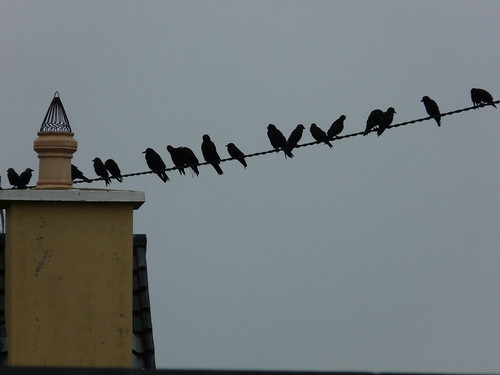
You might be wondering why I have chosen such an ordinary word this week. Well, a few years ago I saw an English film with the curious title A Murder of Crows. I did notice crows in a couple of scenes but none of them was killed, so why this name? Intrigued by the title I did some searching and found to my surprise that murder is a collective noun for crows!
Indeed, there is a long list of fascinating terms for groups of animals. I mention below a selection of the more interesting ones. Here is an enlightening discussion on the origin of the word murder and whether terms such as the following were ever in regular use or just someone's idea of a joke. And another over here.
PS: I have chosen a smaller font size for this post. Please let me know if you prefer this size or the one in the previous posts. Thanks.
Indeed, there is a long list of fascinating terms for groups of animals. I mention below a selection of the more interesting ones. Here is an enlightening discussion on the origin of the word murder and whether terms such as the following were ever in regular use or just someone's idea of a joke. And another over here.
 |
| A venue of vultures Photo: Sentrawoods |
 |
| A murder of crows Photo: Loz Flowers |
- A shrewdness of apes
- A murder / parliament of crows
- A piteousness of doves
- A business of ferrets / flies
- A leap of leopards
- A parliament of owls
- A pandemonium of parrots
- An ostentation of peacocks
- An unkindness of ravens
- A descent of woodpeckers
- A cackle of hyenas
- A crash of rhinos
- A prickle of porcupines
- A cowardice of curs
- A convocation of eagles
- A sounder of pigs
- A venue of vultures
- A kettle of vultures (when circling in the air)
- An ambush of tigers
- A sleuth of bears
- A coalition of cheetahs
- A mischief of mice
PS: I have chosen a smaller font size for this post. Please let me know if you prefer this size or the one in the previous posts. Thanks.
Wednesday, 25 August 2010
Marriage vs Wedding
I got the idea for today's post while reading a news article about Shashi Tharoor's wedding which said: About 100 close relatives, including 20 from Pushkar's side, attended the marriage...(http://in.news.yahoo.com).

Nevertheless, wedding should be the preferred word since it refers specifically to the ceremony.

You can easily remember this distinction if you keep in mind the following film-titles, all of which use wedding rather than marriage.
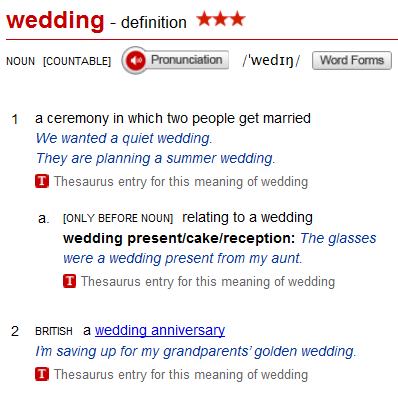
Many people in India use the word marriage when referring to the ceremony where a marriage takes place, instead of the more appropriate wedding. However, the use of marriage in this context is not wrong, as is apparent from the second definition of the word shown in this screenshot from the Macmillan dictionary.

Nevertheless, wedding should be the preferred word since it refers specifically to the ceremony.
You can easily remember this distinction if you keep in mind the following film-titles, all of which use wedding rather than marriage.
- My Big Fat Greek Wedding
- My Best Friend's Wedding
- Monsoon Wedding
Sunday, 15 August 2010
Word of the Week: Triskaidekaphobia
Noun. Pronounced tris-kai-deka-FObia
Listen to the word here.
The superstition that the number thirteen brings bad luck is common in many parts of the world. This fear is such that many hotels and apartment buildings don't have a thirteenth floor or a room numbered thirteen. This irrational fear is known by the tongue-twister triskaidekaphobia. I chose this as the Word of the Week as we have just passed Friday the 13th, a date which is feared to be so unlucky that it has been used as the name of a horror movie.
Listen to the word here.
 |
| Where's the 13th floor? Photo: Quinn Anya |
The superstition that the number thirteen brings bad luck is common in many parts of the world. This fear is such that many hotels and apartment buildings don't have a thirteenth floor or a room numbered thirteen. This irrational fear is known by the tongue-twister triskaidekaphobia. I chose this as the Word of the Week as we have just passed Friday the 13th, a date which is feared to be so unlucky that it has been used as the name of a horror movie.
Wednesday, 11 August 2010
Who vs Whom
It seems to me that many people, not just Indians, do not use the pronoun whom very often, if at all; maybe they do not know when to use it, so they just stick to who.
In order to get an idea of how widespread this practice is, I googled "who did he talk to" and got 599,ooo results. Then I searched the grammatically correct version of that sentence, "whom did he talk to", and got a mere 49,000 results!
I performed another search and the results were equally revealing. This time I entered "who do you think you are talking to" and it's grammatically correct sibling "whom do you think ..."; the results for the former were many times greater than for the latter.
But it's not difficult to understand if you put in a little effort. Let me explain.
Who and whom are used just like he and him. All four of these words are pronouns; who and he are known as 'subject pronouns' while 'whom' and 'him' are 'object pronouns'. The subject of a sentence is a noun or a pronoun which performs an action and the object is the recipient.
Let's take an example. Let's suppose that a female teacher scolded one of her male students. Using pronouns we can say:
"She scolded him." The female teacher was the one who performed the action, so she is the subject and is represented by the subject pronoun she, and the student is represented by the object pronoun him.
If you don't know who the recipient of the action was then you can ask the question "Whom did she scold?" using the object pronoun whom. Here, who would have been wrong since it can represent only the subject of a sentence, which in our example is the teacher.
Let's take the first sentence that I googled, "who did he talk to". Imagine yourself answering that question with "he talked to ____". Here, he is the subject since he is the one performing the action of talking. So the pronoun to fill the blank will have to be the object pronoun whom, not the subject pronoun who.
Similarly, if you were to answer the second sentence, "who do you think you are talking to", you would say "I am talking to _____". Here again, I is performing the action and is therefore the subject and the recipient of the action, and the object, needs to be represented by the object pronoun whom.
I hope I haven't confused you further. More lucid explanations can be found here and here.
In order to get an idea of how widespread this practice is, I googled "who did he talk to" and got 599,ooo results. Then I searched the grammatically correct version of that sentence, "whom did he talk to", and got a mere 49,000 results!
I performed another search and the results were equally revealing. This time I entered "who do you think you are talking to" and it's grammatically correct sibling "whom do you think ..."; the results for the former were many times greater than for the latter.
But it's not difficult to understand if you put in a little effort. Let me explain.
Who and whom are used just like he and him. All four of these words are pronouns; who and he are known as 'subject pronouns' while 'whom' and 'him' are 'object pronouns'. The subject of a sentence is a noun or a pronoun which performs an action and the object is the recipient.
Let's take an example. Let's suppose that a female teacher scolded one of her male students. Using pronouns we can say:
"She scolded him." The female teacher was the one who performed the action, so she is the subject and is represented by the subject pronoun she, and the student is represented by the object pronoun him.
If you don't know who the recipient of the action was then you can ask the question "Whom did she scold?" using the object pronoun whom. Here, who would have been wrong since it can represent only the subject of a sentence, which in our example is the teacher.
Let's take the first sentence that I googled, "who did he talk to". Imagine yourself answering that question with "he talked to ____". Here, he is the subject since he is the one performing the action of talking. So the pronoun to fill the blank will have to be the object pronoun whom, not the subject pronoun who.
Similarly, if you were to answer the second sentence, "who do you think you are talking to", you would say "I am talking to _____". Here again, I is performing the action and is therefore the subject and the recipient of the action, and the object, needs to be represented by the object pronoun whom.
I hope I haven't confused you further. More lucid explanations can be found here and here.
Subscribe to:
Posts (Atom)