Sticking to the world of music, today's word is mondegreen. You may have never heard or read this word before but it refers to something that you are certainly familiar with.
A mondegreen is simply a word or group of words that a person mishears in a song. (You can listen to the pronunciation of the word here).
A famous example of a mondegreen is the title of the well-known series of travel guides, Lonely Planet. The founders of this series, Tony and Maureen Wheeler, gave their guidebooks this name after they heard the words lonely planet in a song. It was only later that they realised that the real lyrics were lovely planet.
Take a look at this hilarious Youtube video of Nelly Furtado's I'm like a bird:
And this video of Livin' la vida loca by Ricky Martin.
Wednesday, 18 May 2011


Sunday, 1 May 2011
Earworm
Most people have had the unpleasant experience of a song playing endlessly in their heads and not knowing how to stop it. Well, now you know what to call it: earworm, which is a literal translation of the German word ohrwurm.
Wikipedia defines earworm as a portion of a song or other music that repeats compulsively within one's mind, put colloquially as "music being stuck in onés head ."
There is even a website dedicated to earworms.
Wikipedia defines earworm as a portion of a song or other music that repeats compulsively within one's mind, put colloquially as "music being stuck in onés head ."
There is even a website dedicated to earworms.
Wednesday, 20 April 2011
Lakhs and crores
The terms lakh and crore are widely used in the English-language media in India — in newspapers and magazines, tv channels, government publications and even in the financial statements of Indian companies — and I think it is about time that we shifted to using hundred thousand and million instead.
The Indian economy has been growing fast for many years and so has international trade but we are still out of tune with the rest of the world in this respect. We use the Gregorian calendar rather than the Hindu calendar, don't we? So why not dispense with lakh and crore, which are understood only in South Asia, and start using the standard terms which are understood throughout the world. Of course, we should continue using lakh and crore in the Hindi language.
What do you think?
The Indian economy has been growing fast for many years and so has international trade but we are still out of tune with the rest of the world in this respect. We use the Gregorian calendar rather than the Hindu calendar, don't we? So why not dispense with lakh and crore, which are understood only in South Asia, and start using the standard terms which are understood throughout the world. Of course, we should continue using lakh and crore in the Hindi language.
What do you think?
Sunday, 6 March 2011
Flammable vs Inflammable
You must have read the words Highly Inflammable painted on many oil tankers in India and Highly Flammable on others. That's really odd; isn't inflammable the opposite of flammable? Is there a difference in the type of fuel that they carry?
This is one of those things in the English language that leave you scratching your head. Adding the prefix in- usually turns the meaning of a word on its head: for example, injustice is the opposite of justice. But in the case of the words flammable and inflammable, both mean the same thing — "likely to burn easily and quickly" — and can be used interchangeably when talking about materials, like fuel and cloth. The opposite of these words is non-flammable.
Inflammable can also be used in a figurative sense to mean "easily aroused to anger or passion" (Collins Dictionary).
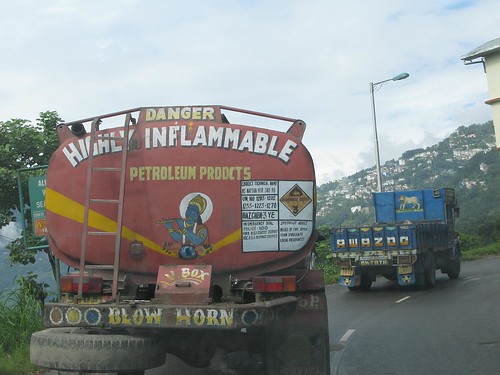 |
| Image: Hockadilly |
This is one of those things in the English language that leave you scratching your head. Adding the prefix in- usually turns the meaning of a word on its head: for example, injustice is the opposite of justice. But in the case of the words flammable and inflammable, both mean the same thing — "likely to burn easily and quickly" — and can be used interchangeably when talking about materials, like fuel and cloth. The opposite of these words is non-flammable.
Inflammable can also be used in a figurative sense to mean "easily aroused to anger or passion" (Collins Dictionary).
Thursday, 3 February 2011
Diffuse vs Defuse
The words diffuse and defuse are frequently confused in Indian publications, probably because they sound so similar. Here are three examples:
- The Zakir Nagar area near Jamia Nagar in southeast Delhi was tense after mobs surrounded an Uttar Pradesh police team and allegedly beat them up when they came to arrest an accused wanted in a burglary case in western Uttar Pradesh. The SHO of Jamia Nagar had to lead a team to the area to diffuse the tension. (Times of India, Jan 20, 2011)
- The Congress central leadership has promptly swung into action to diffuse the crisis in Andhra Pradesh when a group of newly sworn-in ministers rebelled against the chief minister Nallari Kiran Kumar Reddy protesting that they were given insignificant portfolios. (Live Mint, Dec 02, 2010)
- The police are likely to hold similar recruitment drives in all the other areas of the old city. The police see the drive as a move to diffuse another "possible uprising" in 2011. (India Today, Jan 13, 2011).
Subscribe to:
Posts (Atom)