It seems to me that many people, not just Indians, do not use the pronoun whom very often, if at all; maybe they do not know when to use it, so they just stick to who.
In order to get an idea of how widespread this practice is, I googled "who did he talk to" and got 599,ooo results. Then I searched the grammatically correct version of that sentence, "whom did he talk to", and got a mere 49,000 results!
I performed another search and the results were equally revealing. This time I entered "who do you think you are talking to" and it's grammatically correct sibling "whom do you think ..."; the results for the former were many times greater than for the latter.
But it's not difficult to understand if you put in a little effort. Let me explain.
Who and whom are used just like he and him. All four of these words are pronouns; who and he are known as 'subject pronouns' while 'whom' and 'him' are 'object pronouns'. The subject of a sentence is a noun or a pronoun which performs an action and the object is the recipient.
Let's take an example. Let's suppose that a female teacher scolded one of her male students. Using pronouns we can say:
"She scolded him." The female teacher was the one who performed the action, so she is the subject and is represented by the subject pronoun she, and the student is represented by the object pronoun him.
If you don't know who the recipient of the action was then you can ask the question "Whom did she scold?" using the object pronoun whom. Here, who would have been wrong since it can represent only the subject of a sentence, which in our example is the teacher.
Let's take the first sentence that I googled, "who did he talk to". Imagine yourself answering that question with "he talked to ____". Here, he is the subject since he is the one performing the action of talking. So the pronoun to fill the blank will have to be the object pronoun whom, not the subject pronoun who.
Similarly, if you were to answer the second sentence, "who do you think you are talking to", you would say "I am talking to _____". Here again, I is performing the action and is therefore the subject and the recipient of the action, and the object, needs to be represented by the object pronoun whom.
I hope I haven't confused you further. More lucid explanations can be found here and here.
Wednesday, 11 August 2010


Saturday, 24 July 2010
Word of the Week: Vomitorium
Noun. Pronounced: vomi-TOR-i-um
Listen to the word here.
The image that came to my mind, the first time I saw this word, was of a place meant for people to vomit in. It turned out to be something very different. And far more pleasant.
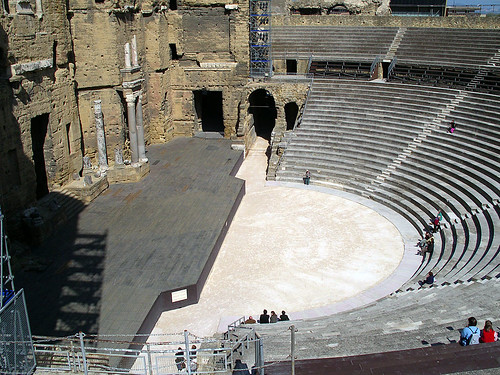
Vomitoria were the wide passageways in ancient amphitheatres through which large numbers of spectators could enter and exit. These days most sports stadiums and movie theatres have vomitoria.
Both vomit and vomitorium come from the Latin vomere, 'to spew forth, to discharge'.
Incidentally, amphitheatres were called so because they were circular in shape whereas theatres used to be semi-circular; the prefix amphi is Greek for 'both' or 'on both sides', hence a theatre on both sides would make an amphi-theatre. Clever!
Listen to the word here.
 | ||
| A vomitorium. Photo courtesy: York University |
 | |
| Vomitoria at an ancient Roman amphitheatre. Photo courtesy: Sebastiá Giralt |
The image that came to my mind, the first time I saw this word, was of a place meant for people to vomit in. It turned out to be something very different. And far more pleasant.
Vomitoria were the wide passageways in ancient amphitheatres through which large numbers of spectators could enter and exit. These days most sports stadiums and movie theatres have vomitoria.
Both vomit and vomitorium come from the Latin vomere, 'to spew forth, to discharge'.
Incidentally, amphitheatres were called so because they were circular in shape whereas theatres used to be semi-circular; the prefix amphi is Greek for 'both' or 'on both sides', hence a theatre on both sides would make an amphi-theatre. Clever!
 |
| A theatre. Photo courtesy: Phil Gyford |
 |
| An amphitheatre. Photo courtesy: http2007 |
Thursday, 15 July 2010
Word of the Week: Schadenfreude
Noun. Pronounced SHAA-d'n-froi-der
Listen to the word here.
Childless couples often go to great lengths to conceive a child of their own. If in spite of their efforts and money spent they are unable to do so, they may decide to undertake the time-consuming procedure of adopting a baby.
Fortunately, adopting a word from another language is much simpler: there are no forms to fill, no interviews with the adoption agency and no house-visits. If you like a word, just take it!
I fell in love with this word the first time I saw it and came to know what it meant. It is a German word, adopted by the English language since it has no equivalent of its own. Its meaning: pleasure derived from others' misfortune.
Schadenfreude is what a political party in the opposition would feel on seeing the government in hot water due to a financial scandal. Or what a businessman would feel on seeing a competitor suffer big losses. Or ... you get the picture, right? And here are some funny examples that I came across.
Monday, 12 July 2010
LIC, mediclaim and xerox
Until a few years ago the insurance industry in India consisted only of public sector companies: Life Insurance Corporation (LIC) was the only company selling life insurance policies and there were four public sector firms selling general insurance products like medical, householder's and vehicle insurance policies.
Mediclaim is the brand name of the medical insurance policy offered by public sector general insurance firms, but it is widely used generically, even in the Press, to refer to policies sold by the private companies as well.
Likewise, xerox (from Xerox Corporation, manufacturer of photocopiers) is used both as a noun and as a verb to mean (to) photocopy. And the popularity of the Hoover vacuum cleaner in the US led to it being used as a verb: to hoover, meaning to vacuum.
Do you know of any other brand names being used generically?
Mediclaim is the brand name of the medical insurance policy offered by public sector general insurance firms, but it is widely used generically, even in the Press, to refer to policies sold by the private companies as well.
Likewise, xerox (from Xerox Corporation, manufacturer of photocopiers) is used both as a noun and as a verb to mean (to) photocopy. And the popularity of the Hoover vacuum cleaner in the US led to it being used as a verb: to hoover, meaning to vacuum.
Do you know of any other brand names being used generically?
Sunday, 4 July 2010
Word of the Week: acnestis
Everyone suffers an itch now and then. But when it is on that part of the back where you just cannot reach, no matter how you contort your body, it can get really annoying. You must have seen cattle rubbing their backs against tree-trunks and dogs writhing on the ground on their backs trying to relieve a persistent itch.
And would you believe it! There is a word for it! Seriously. It's called acnestis: the part of an animal's back where it cannot scratch itself.
Although this term is used with respect to quadrupeds (an animal that walks on four legs) nothing stops us from using it to refer to the same part of our anatomy.
And would you believe it! There is a word for it! Seriously. It's called acnestis: the part of an animal's back where it cannot scratch itself.
Although this term is used with respect to quadrupeds (an animal that walks on four legs) nothing stops us from using it to refer to the same part of our anatomy.
Subscribe to:
Posts (Atom)